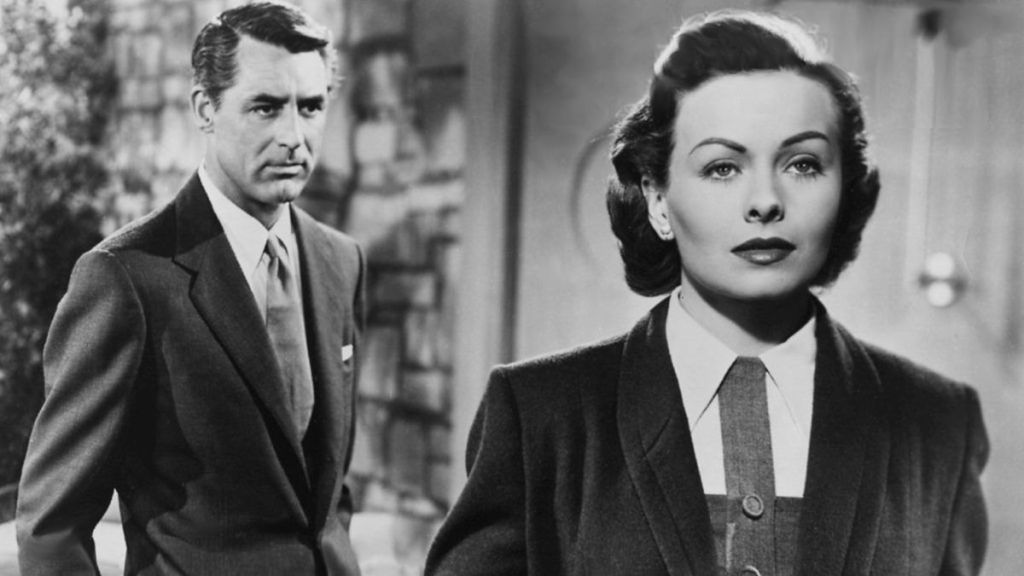
A somewhat perfunctory story is enlivened by a strong cast and a sharp screenplay in Joseph L. Mankiewicz’s 1951 romantic comedy-drama People Will Talk. Based on a German play by Curt Goetz, it is a bright little gem for fans of classic Hollywood.
Dr Noah Praetorius (Cary Grant) is a popular physician and lecturer with a strong rapport with his patients and an easy-going attitude with students. When he meets troubled student Deborah Higgins (Jeanne Crain), he is immediately drawn to help her. Meanwhile a jealous colleague (Hume Cronyn) grows suspicious of Noah’s shadowy past, and his friendship with the mysterious Mr Shunderson (Finlay Currie).
Mankiewicz’s screenplay is the real star here, offering an engaging romantic drama with a sense of mystery and an array of pleasing, larger-than-life characters. It presents marvellous material to the film’s cast, who each take hold of their respective characters with both hands. It is a lively, genuinely enjoyable affair with a light, airy tone and some exceptionally witty dialogue. Cary Grant is predictably charming as the debonair Dr Praetorius, while Hume Cronyn does a wonderfully bitter job as his professorial rival Rodney Elwell. Jeanne Crain also performs well as Deborah, although as is often the case for the time the female roles are rather under-written – however well costumed. Margaret Hamilton, best known as the Wicked Witch of The Wizard of Oz makes a delightfully cantankerous cameo in the film’s opening scene as a suspicious former housekeeper of Praetorius’, summoned to meet with Professor Elwell.
Dialogue, performances, and production values are all wonderful, but sadly the film struggles a little in terms of plot and character. The film is dominated by a looming mystery over Praetorius’ past, and the reason why his quiet, constant companion Shunderson is always by his side. When those answers do come during a climactic college interrogation, they are arguably not as satisfying as the anticipation suggested. That said, Finlay Currie does a marvellous job with Shunderson – whose own back story is revealed to be a lot more interesting than his friend’s. It is a fascinating, somewhat unique character and Currie plays him memorably.
At the same time the film practically deifies Praetorius as the most good-hearted of the good, when some of his behaviour – notably his romancing of one of his students – has dated rather badly. It is, in the end, a film of its time, but for the 21st century audience he is not the shining exemplar the film suggests him to be.
There is some fairly bold content for 1951 Hollywood: Mankiewicz takes pains not to demonise or unfairly judge Deborah for being single and pregnant when she meets Praetorius, which does feel progressive for the time. In the end, however, it is the sharp dialogue that works the most effectively – and remains the best reason to track down and sample this elegant comedic drama.




 FictionMachine.
Leave a comment