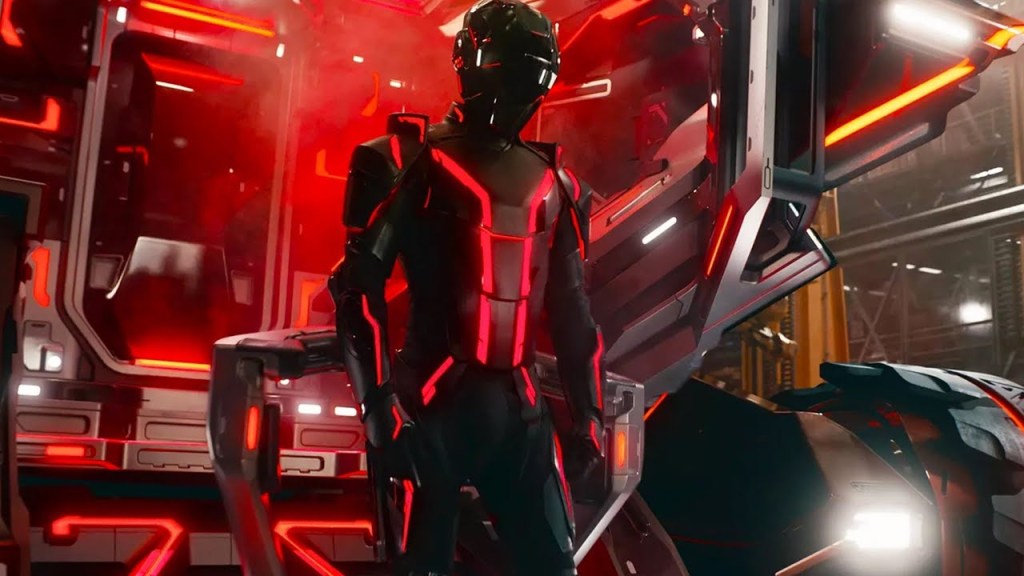
Steven Lisberger’s Tron (1982) is a strange cult science fiction film that capitalised on an early 1980s videogaming boom to build an iconic and ambitious visualisation of people living inside a computer. Joseph Kosinski’s Tron: Legacy (2010) is an effective and supremely watchable high budget celebration of that original film, telling a deliberately simple story as an excuse to showcase a glossy fulfilment of the original’s aesthetic potential. Joachim Rønning’s Tron: Ares (2025)? Well, it’s a sequel, I guess. Things happen. The audience’s eyes are fed some candy. The narrative limitations of Tron as an ongoing franchise are laid out clearly for all to see. It is the third Tron film, and also the third-best Tron film. Your personal experience may, of course, vary, but I have seen individuals wax lyrical about Tron, and heard people praise Tron: Legacy and its evocative Daft Punk musical score, and hand on heart I cannot imagine anyone getting too excited about Ares.
Anyone expecting the new film to pick up on characters and story threads from Legacy are going to walk away disappointed. Ares functions less like a third film and more like a second second film. Two rival corporations, ENCOM and Dillinger Systems, are in a race to develop technology that can 3D-print complex objects – including living people. For ENCOM CEO Eve Kim (Greta Lee), it will mean feeding the world with unlimited food and shelter. For rival CEO Julian Dillinger (Evan Peters), it is a tool to create the world’s most effective military technology. The centrepiece of Dillinger’s efforts is an AI code-named Ares (Jared Leto), who is capable of exiting virtual world “the Grid” and operating in our real world for 29 minutes at a time.
The science of science fiction cinema is usually nonsense, and certainly in the Tron films it has been a total nonsense – acting purely as a means of throwing a protagonist into a Atari-inspired variation of a planetary romance. Ares tries something different, not only bringing AI characters back the other way into the human world but basing a solid half of its focus on an AI protagonist. Both are, for the record, terrible story-breaking ideas – and not just because of the struggle not to think about the physics of it all.
In the first case, it ruins the core conceit of Tron as expressed in the first two films. While there are scenes set on the Grid, they lack any sort of wonder or visual spectacle that powered the earlier works. Shifting the digital people and machines of the Grid into present-day America does not achieve the same effect, and leaves Ares feeling more inspired by Terminator than Tron.
In the second, it is simply more difficult to engage with a protagonist that effectively cannot die, and whose worst consequence of dying in the real world is having to be regenerated back in the building where they started. Jared Leto, a deeply problematic actor, plays Ares with a level of deadpan understatement to make one swear the role was developed for Keanu Reeves (who would have aced it, by the way). Other actors, like Greta Lee, Evan Peters, Gillian Anderson, and Jodie Turner-Smith, bring a lot of talent to roles that aren’t really written for talent to flourish. Jeff Bridges, star of the first two Trons, returns briefly as Kevin Flynn; it is a victory lap, with no real reason for him to be there.
A slightly over-powering score by Nine Inch Nails fails to make the impact that Daft Punk had on Legacy. It is really a question of fit. Daft Punk suited the earlier story, and I’m not sure NIN do so here.
Neither particularly awful nor particularly great, Tron: Ares is an unambitious IP extension. It is capably written, and capably directed by Joachim Rønning. It isn’t very interesting, nor is it very necessary. Honestly, with AI making headlines all the time you would think it had something more interesting to say.



 FictionMachine.
Leave a comment