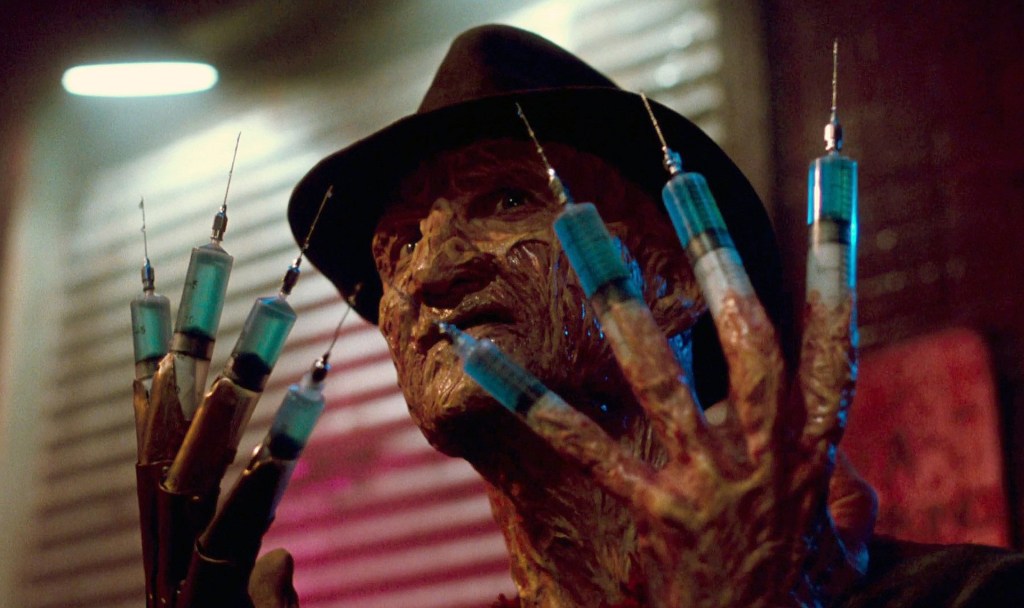
When A Nightmare on Elm Street returned for its third film, it not only left the titular street – it partially left the horror genre.
There is a marked shift in tone with Dream Warriors, one that pushes the franchises into a sort of dark fantasy mode. Freddy Krueger (Robert Englund) returns – as does the first film’s Nancy Thompson (Heather Langenkamp) – but the setting is a psychiatric hospital, and the teenage characters are a lot more distinctive and heroic. It is really this third film, in the hands of director Chuck Russell and writers including Wes Craven and Frank Darabont, that cements Elm Street as an ongoing movie franchise.
Teenager Kristen Parker (Patricia Arquette) is targeted in a dream by supernatural serial killer Freddy Krueger (Robert Englund). While she survives his attack, the slashes on her wrists – that look like a suicide attempt – see her committed to a psychiatric hospital for treatment. When Freddy attacks Kristen again, she is saved by the facility’s new intern Nancy Thompson – the sole survivor of Freddy’s original unearthly rampage.
Kristen’s psychic gift, which allows her to drag other people physically into her dreams, means that this time around Freddy’s intended victims can group together and fight back. It also solidifies the idea of Freddy murdering each character through individual dream vignettes based on their specific personalities and fears – something that largely becomes the formula for the next three movies in the series.
The film does a great job of bringing Nancy Thompson back into the narrative. It not only links it back to the original film more coherently than Freddy’s Revenge did, it provides Heather Langenkamp with an uncharacteristic amount of character development for the new film. She was a teenager in the original, but now she is an adult with greater resolve and a stronger sense of responsibility. Horror films are hardly renowned for their good character work, and what the script does for Nancy here is decent stuff. The film also expands on the strength of Nancy’s character with the inclusion of Arquette as Kirsten and Jennifer Rubin as recovering addict Taryn White: two strong-willed characters with a decent amount of agency, who transcend the standard victim model of the genre. Other actors are less fortunate: Bradley Gregg’s Philip and Penelope Sudrow’s Jennifer largely exist to be murdered, but at least receive the benefit of a memorable death. Some of the most iconic death scenes of the whole Elm Street series take place in Dream Warriors: Philip – an amateur puppeteer – gets turned into a grisly marionette before falling from the hospital’s clock tower, while aspiring actor Jennifer gets her head shoved violently into a television.
Enthusiastic actor-spotters will enjoy watching Laurence Fishburne – still credited in his early roles as Larry – playing a hospital orderly.
Dream Warriors is less frightening than its predecessors, but it arguably funnier and more imaginative. Freddy is pushed in a more comedic direction, and this is a trend that will be sequentially pushed further with every future sequel. The end result is a film that, while never quite reaching the quality of Wes Craven’s original work, stands up as a particularly strong sequel – taking up the ingredients of the format and set-up, and remixing them into an entertaining new variation.

 FictionMachine.
Leave a comment