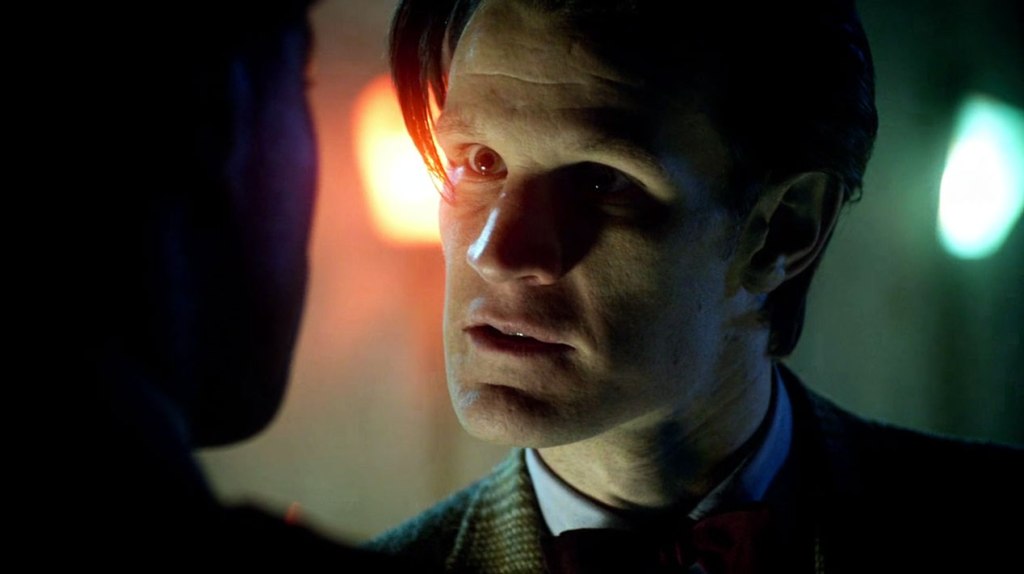
First broadcast 4 June 2011.
When originally broadcast in 2011, Doctor Who‘s sixth season was split into two halves, and this – the seventh episode – was the climactic instalment of the first section. As a result it functions largely as a mini-finale, tying together multiple plot threads and ongoing mysteries together. Does it work? We’ll get to that; first let us summarise where the season has gone up to this point.
The Doctor (Matt Smith) will be assassinated by a space-suit-wearing assailant in 2011 Utah. The Doctor doesn’t know this, but his companions Amy (Karen Gillen) and Rory (Arthur Darvill) do. The assassin may be a small girl kidnapped by the alien Silents in 1969 Florida; those same Silents have clearly built the killer’s space-suit, and are linked to an attempt to destroy the TARDIS back in the Season 5 finale.
Amy thought she was pregnant, but then admitted that she wasn’t – only scans conducted in secret by the Doctor have revealed her to be in some quantum state where she is both pregnant and not pregnant at the same time. Amy has also been hallucinating a stern woman with an eye patch who keeps appearing to her in different places in time and space. It turns out the Amy that has been travelling with the Doctor and Rory was a fake, linked mentally to the real Amy – who is a prisoner of the eyepatch woman until she gives birth to a very real baby.
Let’s put a pin in that one for a paragraph or two, because it is also worth remembering that back in 2008 the previous Doctor (David Tennant) met the time-travelling archaeologist River Song. He had never met her before, but she was clearly familiar enough with his future to know him intimately as well as know his actual name. The Doctor met her again twice in Season 5, where the audience learned that at some point she was imprisoned for murder and that she was clearly a significant figure in the Doctor’s future life. The very heavy implication was that she was both the Doctor’s wife and his future murderer.
That is quite a bit of back story really, going back well before the current season, and what is more that back story has been maddeningly vague throughout. It is also worth noting this sort of complicated puzzle box storytelling is unprecedented for Doctor Who. Furthermore it is committing what strikes me as a cardinal sin with these sorts of narratives: don’t ask new questions before answering some old ones. Keep all of the above in mind, and it is not a surprise to find “A Good Man Goes to War” is essentially crushed by expectations that showrunner Steven Moffat set up for himself. By the end of the hour, some long-running questions are answered. Some are not. At the same time, the violent confrontation promised by the episode itself has simply failed to occur.
The episode’s key focus is the Doctor invading the secret space station Demon’s Run to rescue Amy and her baby. To achieve this, he assembles what is effectively a Magnificent Seven-style posse; I would compare it instead to Kurosawa’s Seven Samurai, but the season has already invested heavily in western imagery in “The Impossible Astronaut” so The Magnificent Seven simply feels more appropriate. Introducing Madame Vastra (Neve McIntosh), the sword-wielding 19th century Silurian detective, and her maid-turned-wife Jenny (Catrin Stewart), as well as the Sontaran Nurse Strax (Dan Starkey). Rory comes to the battle in full Roman Centurion uniform. The episode’s original storyline even included former companion Jack Harkness; actor John Barrowman was busy shooting Torchwood. C’est la vie.
Properly introduced this episode is the mysterious “eyepatch lady” (Frances Barber), who has masterminded Amy’s kidnapping and who plans to steal her baby. The episode also introduces blue-skinned information broker Dorium Maldovar (Simon Fisher-Becker), features the Headless Monks mentioned back in “The Time of Angels”, references the Papal Mainframe (that will turn up in 2013’s “The Time of the Doctor”), and includes nods and cameos from “The Doctor’s Wife”, “Victory of the Daleks”, and “The Hungry Earth”.
That is a lot of noise for one episode – albeit nicely directed by Peter Hoar – and it’s striking that once all of the portent and foreshadowing is done, there is precious little to the episode at all. People talk about the Doctor, the Doctor turns up, baby gets kidnapped. The episode promises a balls-to-the-wall action spectacle, but then refuses to provide one. It foreshadows the Doctor’s greatest heights and deepest lows, then fails to present anything particularly high or low. On the one hand it is smart, because action spectacle and space wars are not what the Doctor really does. On the other hand it is immensely frustrating for two key reasons.
The first reason is simply a lack of resolution. Amy’s phantom pregnancy is resolved. We learn that the eyepatch-wearing ruler of Demon’s Run is stealing Amy and Rory’s baby because it was conceived in the TARDIS and thus has Time Lord characteristics. We do learn River Song’s real identity, which counts for a lot. At the same time we are still no wiser about the space-suit in Utah, what connects Demon’s Run to the Silents, whether it directly links to the destruction of the TARDIS in Season 5, or why eyepatch lady is so intent on killing the Doctor.
To be honest, those frustrations are relatively minor. Season 6 has six more episodes to go, so there is time to tie things together and make sense of them all. This is the frustration of puzzle box storytelling: you cannot really criticise it until it is done. The properly frustrating part of the episode is Amy Pond.
Put simply, Amy has no agency in what should be her own story. She has been kidnapped and forced to give birth by her captors. Her baby in turn is stolen from her, apparently to become a weapon to kill the Doctor. Somehow Amy is the one who is imprisoned, assaulted, and traumatised, yet it is the Doctor’s story. She is not even the focus of his attention once events start happening.
The best part of the episode? A soldier named Lorna Bucket (Christina Chong). She encountered the Doctor as a child, and became a military cleric in the hopes of meeting him again. She helps his storming of Demon’s Run, and is fatally wounded for her troubles. The Doctor is brought to her in her final moments, and consoles her: didn’t we run? Wasn’t our earlier adventure amazing. The Doctor, as it becomes palpably clear, has absolutely no idea who she is. It is the safest bluff he could make: that he met someone, and that they inevitably ran down a corridor away from a monster.
It is the strongest element of a messy, frustrating episode. When reviewing season premiere “The Impossible Astronaut”, I made a point of highlighting how large and noisy the Doctor had become: waving from Laurel and Hardy films, and turning up in history books. In “Silence in the Library” and “The Eleventh Hour” Steven Moffat presented a Doctor who cast such a shadow over the universe that he won battles purely through referencing his own reputation. With Lorna, Moffat now presents a Doctor so epic in status that he no longer remembers the people he saves. The Doctor does not even appear in this episode until about the 20-minute mark. Before then, scenes are dominated by people discussing his reputation. This progression is, for me, the clever part of what Moffat is doing in Season 6, and it is the elements with Lorna that I love the most about “A Good Man Goes to War”. Frankly, the rest is a bit of a mess.

 FictionMachine.
Leave a comment