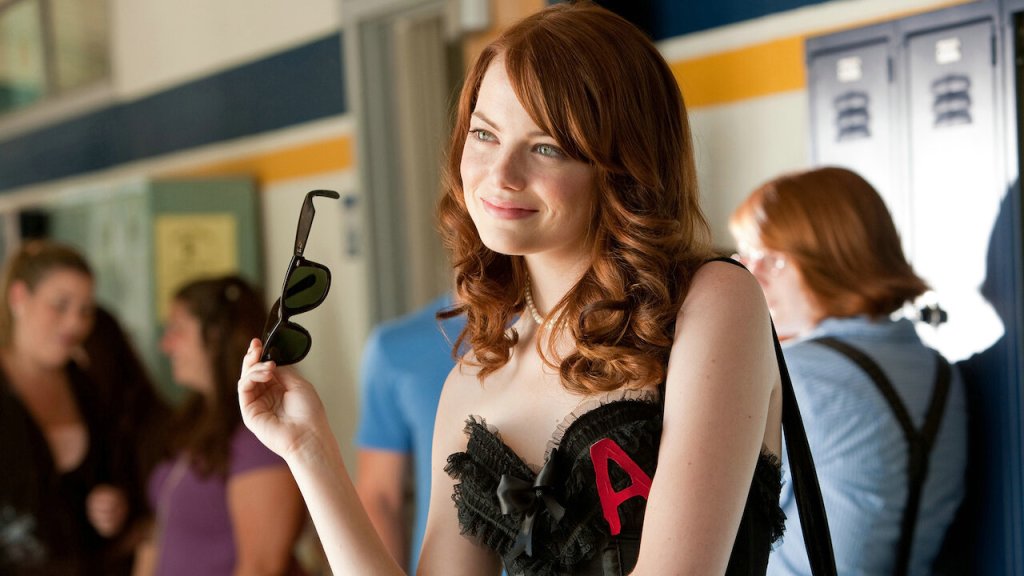
Is it possible that Easy A was the last great teen comedy? Will Gluck’s 2010 high school riff on Nathaniel Hawthorne’s The Scarlet Letter is certainly the last top-notch example I can remember, and certainly it is hard to think of a more recent example with such a high-profile and talented cast.
The film stars Emma Stone as Olive, a high-performing high schooler who lies to a friend, lies again to help a bullied classmate, and then finds herself increasingly buried beneath a crushing pile of innuendo, moral judgement, and regret. It is Gluck’s self-avowed ode to the teen films of writer/director John Hughes, and while Gluck’s film lacks those works’ Chicago location or earnest quality it makes up for those elements with a canny love for pop culture references, self-awareness, and marvellously styled dialogue. Like all great teen films, it portrays characters with an unlikely level of wit and sophistication. You could criticise it for failing to represent an authentic teen America, but you would be criticising it in vain: its creative team are fully aware they are dealing in fantasy.
That goes double for Patricia Clarkson and Stanley Tucci, playing Olive’s overly cool and supportive parents. I cannot imagine there has been a teenager in history with parents so effortlessly likeable, and they make each of their scenes an absolute joy to watch.
School staff are ably represented by Thomas Haden Church and Lisa Kudrow (who plays sharply against type), as well as an oddly cast Malcolm McDowell as the Principal. Olive’s fellow students are well performed by Amanda Bynes, Penn Badgley, Aly Michalka, and Oliver Platt Mini-Me Dan Byrd. They represent a particularly talented ensemble, each finding their own personal moments to shine and ably supporting Olive’s central journey.
Emma Stone is enormously charismatic here, representing a character who combines a wise-beyond-her-years sophistication with a believable and specific kind of teenage kid stupidity. Stone had already made a great impact on teen audiences with 2007’s Superbad, and Easy A gives her the opportunity to take the spotlight almost entirely for herself.
Easy A works for multiple reasons. For one thing it is properly funny stuff, and comes packed with well-targeted one-liners and amusing banter. For another it actually boasts a genuinely wise social commentary at its centre. It is wonderfully cine-literate: Gluck’s adoption of teen movie stereotypes – only to either note them or subvert them – gives the movie a pleasing familiarity. It is also surprisingly untidy in place: not every plot thread gets tied off neatly, and not everything feels entirely resolved by the end.
This is a clever comedy that knows its audience and respects it as well. Armed with a witty screenplay and a knockout cast, it has retained its appeal almost 15 years after its original release. Like Natasha Bedingfield’s “Pocketful of Sunshine” within it, the more you experience Easy A the more enjoyable it gets.


 FictionMachine.
Leave a comment