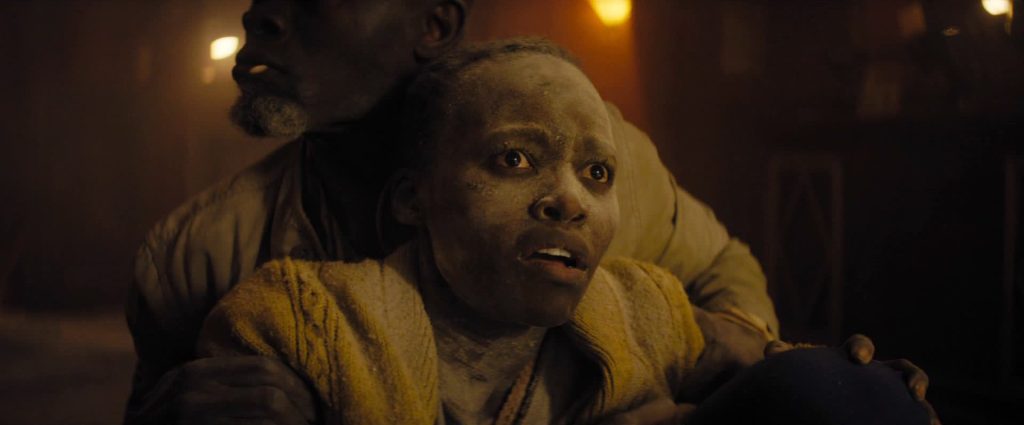
John Krasinski’s A Quiet Place (2018) was, I feel, an effective monster movie but a true mini-masterpiece of sound design. Its commercial success led to a smartly plotted sequel in 2020, and then – when it was clear Krasinski was not ready to immediately follow up with a third film – a largely unrelated prequel in 2024. Krasinski developed some story elements for A Quiet Place: Day One, but it is largely the work of writer/director Michael Sarnoski. That it does not match the heights of the first two films is no surprise nor, even, is it a reason to criticise Sarnoski’s take on the material. Taken on its own merits, this is an effective and tense horror film. It is only when considered alongside the main Quiet Place narrative that it feels underwhelming and unnecessary.
Sam (Lupita Nyong’o) is a terminally ill cancer patient on a day trip to New York when the city is showered with meteors and a veritable army of savage alien creatures emerge to kill everyone. The creatures are blind but have very accurate hearing, leading to a tense journey through the ruined city by Sam, her pet cat Frodo, and English law student Eric (Joseph Quinn).
It was the sound design of A Quiet Place that made it as good as it was, and even if Sarnoski’s prequel matched those sounds in quality it would still suffer by familiarity. It is an approach audiences have seen – well, heard – twice before. Instead Sarnoski clearly takes the Aliens approach: if one or two sound-seeking alien predators marauding the landscape are effective, what about two or three dozen of them? The first two films were post-apocalyptic, leaving the prequel to showcase the actual apocalypse. Where the original film was intimate and small in scale, Day One swings for the bleachers.
The shadow of 9/11 hangs heavily over the film, particularly in its opening minutes of large explosions, mass panic, and billowing debris covering everything and everyone in a thin white patina of dust. It also cannot avoid inviting comparisons with many other science fiction disaster movies before it. Moment to moment, and in fits and starts, scenes resemble snatches of Cloverfield (2008), Independence Day (1996), and other works. The film builds itself up in crowded territory, and comparisons are inevitable.
One notable line running through the film is the exploits of Sam’s pet cat, which she improbably brings along with her. It is an enormous logical leap for the audience to make: anybody that has ever cared for a cat knows that there is no way it is going to consistently do what Sam says, keep silent when necessary, stick to the plan, or not immediately sell her out to the first rogue alien with a cheesy treat. If one simply throws up their hands and runs with the idea – which, let’s face it, is good advice for any disaster flick – the adventures of Frodo the cat do become a proper highlight. Unlike the standard approach in Hollywood these days, the cat is not computer-generated and instead performed by actual cats Schnitzel and Nico. It brings up ethical questions for sure, but it’s hard to deny that actual cats are a lot more convincing and Sarnoski deliberately drafted the screenplay to keep Frodo laid-back and amusingly relaxed throughout.
Day One is entertaining but unnecessary, with strong performances by Nyong’o, Quinn, and a blink-and-you’ll-miss-him Djimon Hounsou (playing his character from the second Quiet Place). My usual caveats about prequels apply. There is no need to know what that first day of the alien invasion was like, and it adds nothing to the original films. Thankfully, by focusing almost entirely on new characters, it honestly does not have to. This is decent commercial entertainment.
 FictionMachine.
Leave a comment