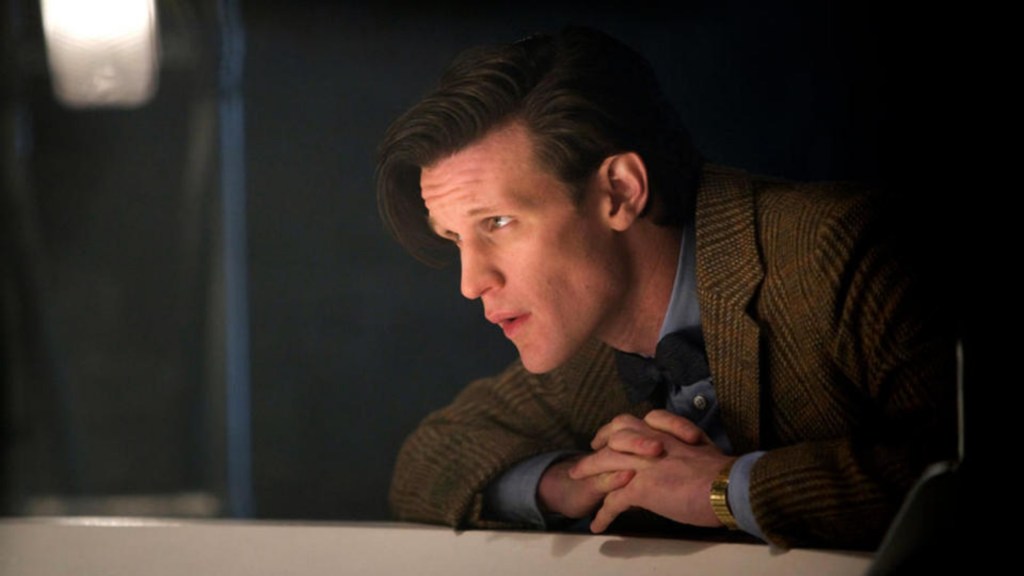
First broadcast 21 May 2011.
For an ostensible science fiction series, Doctor Who has never actually produced a great deal of serious science fiction. That is par for the genre on screen generally of course, since film and television are great at visuals but less efficient at delivering considered ideas and speculation. Now and then, an episode or a movie will slip through and present something with a little more heft to it. I think that is what “The Rebel Flesh” does here.
A solar storm knocks the TARDIS to an island on 22nd century Earth. There a clean-up operation is pumping highly corrosive acid to the mainland. To ensure the safety of the human crew, programmable biological matter – known as Flesh – is pressed into humanoid shapes and controlled remotely by individual workers. When the same solar flare hits the Earth’s atmosphere, the Flesh doppelgangers – nicknamed “Gangers” – spontaneously achieve sentience on their own and fight back against their human controllers.
“The Rebel Flesh” has some interesting stuff to tell its audience about the nature of life, identity, and human prejudice. It does so with a neat and simple set-up, and an easy-to-navigate storyline. In what is a rare occurrence for 21st century Doctor Who, the story has been expanded across two episodes. This gives the narrative room to breathe, and the guest characters space to be more fully explored and established.
The episode is written by Matthew Graham, a key figure in contemporary British television thanks to his co-creation and writing of classic fantasy series Life on Mars and its sequel Ashes to Ashes. His work has also covered numerous dramas since the 1990s including This Life, The Last Train, Hustle, and The Spanish Princess. He writes a properly decent script here, much better than “Fear Her” – his previous contribution to Doctor Who that was nowhere near as effective. The episode is well directed by Julian Simpson (Spooks, Hustle); this and the following episode remain his only contribution to the series.
This story has clearly been produced with Doctor Who‘s limited budget in mind: it keeps to a confined location, and the use of Ganger duplicates effectively delivers twice the cast for the one price. The two-part season premiere, with its Utah locations and wide scope, must have been remarkably expensive – this is the story where Season 6 balances the budget. You can see the limitations in one particularly egregious CGI sequence. To be honest it was probably better left out of the edit.
The guest cast offer strong, realistic performances. Raquel Cassidy is particularly good as local supervisor Cleaves – the sort of defiant authority figure the Doctor always seems to be confronting over the decades – as is Sarah Smart as Jennifer, whose Ganger forms a close relationship with Rory.
Speaking of whom, it is a great episode for Rory and actor Arthur Darvill. There is a constant tendency to shift the character to the background in most episodes, relegating him to warn about the inherent dangers while the Doctor (Matt Smith) and Amy (Karen Gillen) have their adventures. Here he is given much more interesting material, teaming him up with Ganger Jennifer, and it is well written and smartly suited to his character. When Jennifer panics he instinctively moves to help and support her; after all, he is a professional nurse. His immediate compassion for those in need is a pitch perfect representation of his character, and for once it is a motivation based on the episode’s events and not his marriage to Amy. I think Rory is one of the most effective companions Doctor Who ever had, and this episode is simply a superb example of why.
After the two-dimensional whimsy of recent episodes, it is wonderful to see Doctor Who engage in something a bit smarter and more dramatic. All that is left is for the second part, “The Almost People”, to bring the story to a satisfying close.
 FictionMachine.
Leave a comment